NASA Kicks Off Phytoplankton Study
 Phytoplankton bloom off the coast of Iceland
NASA has embarked on a coordinated ship and aircraft observation campaign off the Atlantic coast of the United States, an effort to advance space-based capabilities for monitoring microscopic plants that form the base of the marine food chain.
Phytoplankton, tiny ocean plants that absorb carbon dioxide and deliver oxygen to Earth’s atmosphere, play a major role in the global cycling of atmospheric carbon between the ocean and the atmosphere.
NASA has long used satellites to make observations of the concentration of phytoplankton worldwide, but new types of tools are needed if scientists are to understand how and why different species and concentrations of phytoplankton change from year to year.
For three weeks, NASA’s Ship-Aircraft Bio-Optical Research (SABOR) experiment will bring together marine and atmospheric scientists to tackle the optical issues associated with satellite observations of phytoplankton.
On Friday, July 18, researchers aboard the National Science Foundation’s Research Vessel Endeavor, operated by the University of Rhode Island, will depart from Narragansett, Rhode Island, to study ocean ecosystems from the Gulf of Maine to the Bahamas.
NASA’s UC-12 airborne laboratory, based at NASA’s Langley Research Center in Hampton, Virginia, will make coordinated science flights beginning Sunday, July 20.
“By improving our in-water and aircraft-based measurements of particles and material in the ocean, including phytoplankton, SABOR will advance understanding of marine ecology and the carbon cycle,” said Paula Bontempi, ocean biology and biogeochemistry program manager at NASA Headquarters in Washington.
Knowledge of the vertical distribution of phytoplankton is needed to understand their productivity, which largely drives the functioning of ocean ecosystems. These data will allow NASA scientists to improve satellite-based estimates of how much atmospheric carbon dioxide is absorbed by the ocean.
Simultaneous measurements from the ship will provide a close-up perspective, as well as validate measurements from the aircraft.
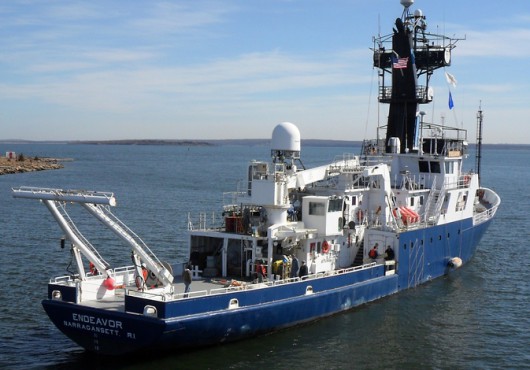
Alex Gilerson of the City College of New York will lead a group on the ship operating an array of instruments including an underwater video camera equipped with polarization vision, which can accurately and continuously measure key characteristics of the sky and the water while underway.
A team led by Ivona Cetinic, of the University of Maine in Walpole, will analyze water samples for carbon, as well as pump seawater continuously through various on-board instruments to measure how ocean particles, including phytoplankton, interact with light.
And a group led by Mike Behrenfeld of Oregon State University in Corvallis will employ a new technique to directly measure phytoplankton biomass along with photosynthesis.
“The goal is to develop mathematical relationships that allow scientists to calculate the biomass of the phytoplankton from optical signals measured from space, and thus to be able to monitor how ocean phytoplankton change from year to year and figure out what causes these changes,” Behrenfeld said.
NASA satellites contributing to SABOR include the Cloud-Aerosol Lidar and Infrared Pathfinder Satellite Observation (CALIPSO), which observes clouds and tiny particles in Earth’s atmosphere, as well as the Terra and Aqua satellites, which measure atmospheric, land and marine processes.
Analysis of the combined data from ship, aircraft and satellites is expected to help guide preparation for a new advanced ocean satellite mission called the Pre-Aerosol, Clouds, and ocean Ecosystem (PACE) mission.
PACE will extend observations of ocean ecology, biogeochemical cycling and ocean productivity begun by NASA in the late 1970s with the Coastal Zone Color Scanner and continued with the Sea-viewing Wide Field-of-view-Sensor (SeaWiFS) and the Moderate Resolution Imaging Spectroradiometer (MODIS) instruments on Terra and Aqua.
Press Release, July 18th, 2014